

Antalya Kaleiçi: A History of the Old Town and What to See
A comprehensive guide to Antalya's old town Kaleiçi — its Roman, Byzantine, Seljuk and Ottoman history, Hadrian's Gate, and the key historic sights worth visiting.
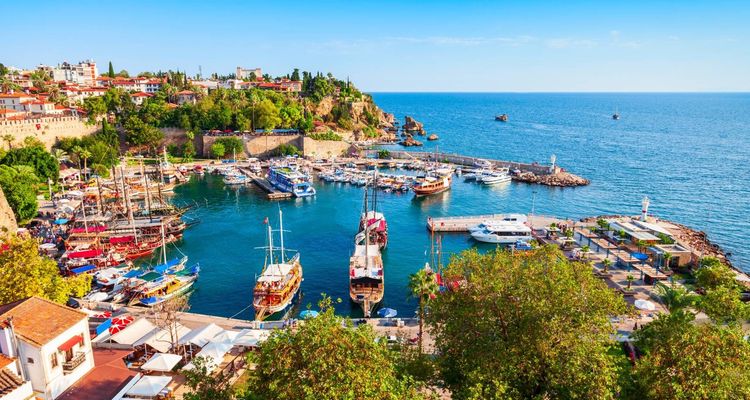
With its narrow streets, ancient walls and wooden Ottoman houses lining the old harbor, Kaleiçi is Antalya's two-thousand-year history still standing today. The district where visitors now stop for coffee and browse small shops is, in fact, a layered open-air museum where the Hellenistic, Roman, Byzantine, Seljuk and Ottoman periods sit one on top of the other. This guide walks through how Kaleiçi's history developed, why Hadrian's Gate matters, the story of the walls and the old harbor, the district's architectural character, and the main sights worth seeing.
What Is Kaleiçi?
Kaleiçi is the historic core of Antalya, the old town enclosed within the city walls. The name itself means "inside the castle" — a settlement that has been protected by walls since the earliest periods of the city. With its narrow stone streets, the square around the old harbor, and Ottoman-era civil houses with their timber bay windows and courtyards, it's Antalya's most distinctive area for a walk today. Right next to the modern city, it feels like a pocket where time has stood still.
How Did Kaleiçi's History Develop?
Antalya was founded in the 2nd century BCE by King Attalos II of Pergamon, and the city was long known as "Attaleia." In 77 BCE, it was incorporated into the Roman Republic, and as the city grew into an important port and trading hub under Roman rule, the core that we know today as Kaleiçi began to take shape. After the division of the Roman Empire, the city passed to Byzantine rule and kept its importance thanks to its strategic position on the Mediterranean. In the early 13th century, the Seljuk Turks conquered the city, and Antalya became one of the main Mediterranean ports of the Anatolian Seljuk state. After the Seljuk state weakened in the late 13th century, the region came under the rule of the Hamitoğulları and later the Teke Beylik that split from it; Antalya later came under Ottoman rule. It was during the centuries of Ottoman administration that the civil architecture we recognize in Kaleiçi today — timber bay-windowed houses, narrow streets, small courtyards — took shape. Walking through the old town today, you're literally stepping on the traces of several civilizations laid one after another.
Hadrian's Gate: The City's Grandest Entrance
Kaleiçi's most recognizable landmark, Hadrian's Gate, was built in 130 CE to commemorate a visit by the Roman Emperor Hadrian. A monumental triple-arched structure in white marble, the gate is built entirely of marble except for its columns and carries a Latin inscription. Its southern tower ("Julia Sancta") is made of plain, undecorated stone blocks and was built at the same time as the gate; the northern tower's lower section dates to Antiquity, while its upper section dates from the Seljuk period. This layering makes Hadrian's Gate a tangible example of how the city was reshaped across different eras, not just one. The gate stayed hidden within the city walls for centuries and was only rediscovered when the surrounding wall remnants were demolished in 1882. Today it's the only surviving gate of the ancient walls that once encircled Antalya.
The Walls: A Shared Legacy from Antiquity to the Ottomans
The walls surrounding Kaleiçi are a shared legacy of the Hellenistic, Roman, Byzantine, Seljuk and Ottoman periods. That's why, walking along the wall line, you can see traces of craftsmanship from different centuries side by side on the same stretch of wall. Under Ottoman rule, the area inside the walls gradually took on a civilian rather than military character, and the Kaleiçi we know today — with its timber houses, narrow streets and small squares — slowly formed within them.
The Old Harbor: The Reason Kaleiçi Exists
The old harbor enclosed by Kaleiçi's walls could be described as the very reason the town has existed for thousands of years. Used as a major naval base and trading harbor in Roman times, this cove kept its strategic importance under Byzantine rule as well — the surrounding walls were, in essence, built to protect it. Today, with small boats moored along its edge and cafés and restaurants lining the shore, the harbor remains the natural centerpiece of any walk through the old town.
Yivli Minaret and Hıdırlık Tower
Two landmarks complete Kaleiçi's skyline: the Yivli Minaret and Hıdırlık Tower. Built by Seljuk craftsmen in the 13th century, the Yivli Minaret is today one of Antalya's most recognized symbols and one of the city's most important Seljuk-era monuments. Hıdırlık Tower, on the other hand, is a monumental structure from the Roman Imperial period, dated to the 1st or 2nd century CE; square at the base and cylindrical above, it's considered one of Anatolia's rare examples of the Roman tradition of monumental tombs. It was later incorporated into the city's defensive system during the Byzantine period.
Why Is Kaleiçi's Architecture So Distinctive?
What makes Kaleiçi architecturally special is that it carries the traces of many overlapping periods rather than just one: Byzantine repairs rising over Hellenistic and Roman foundations, Seljuk towers added on top of those, and, at the very top, the Ottoman-era civilian architecture that defines the streets as we see them today. Ottoman-era houses in particular stand out for their overhanging bay windows, courtyard layouts and mixed timber-and-masonry construction; many of these houses have now been restored into boutique hotels, cafés or small shops. This layering makes Kaleiçi a rare "living history" example on the Mediterranean coast.
How Can You Explore Kaleiçi?
Kaleiçi, with limited vehicle traffic, is one of the easiest districts to explore on foot. Starting at Hadrian's Gate and walking down through the narrow streets toward the old harbor lets you take in both the walls and the historic civil architecture along the way. Stopping by landmarks like the Yivli Minaret and Hıdırlık Tower along the route turns the walk through the old town into a journey through time. The district is also home to historic houses that have gradually been turned into cafés, restaurants and boutique shops — which makes Kaleiçi a lively area where everyday life continues alongside its history.
Want to Explore More of Antalya?
Kaleiçi is only a starting point for getting to know Antalya's historic fabric. For other key stops and general travel information about the city, see our Antalya VIP Transfer & Travel Guide.
Frequently Asked Questions
How old is Kaleiçi?
The walls surrounding Kaleiçi are a shared legacy of the Hellenistic, Roman, Byzantine, Seljuk and Ottoman periods; the district carries traces of all five eras in its present-day form.
Why is Hadrian's Gate so important?
Built to commemorate a visit by Emperor Hadrian in 130 CE, it's the only surviving gate of the ancient walls that once encircled Antalya, and its southern and northern towers carry the marks of different historical periods side by side.
What are the main sights to see in Kaleiçi?
Hadrian's Gate, the Kaleiçi walls, the old harbor, the Yivli Minaret and Hıdırlık Tower are the district's standout historic landmarks.
How much time should I set aside to explore Kaleiçi?
This depends on your interest — visitors who want to take a relaxed walk through the old town's streets, the harbor and its historic buildings may want to set aside more than half a day.

Plan your Antalya VIP transfer
Explore our fixed-rate routes for comfortable airport, hotel, and regional travel.
Book a Transfer